
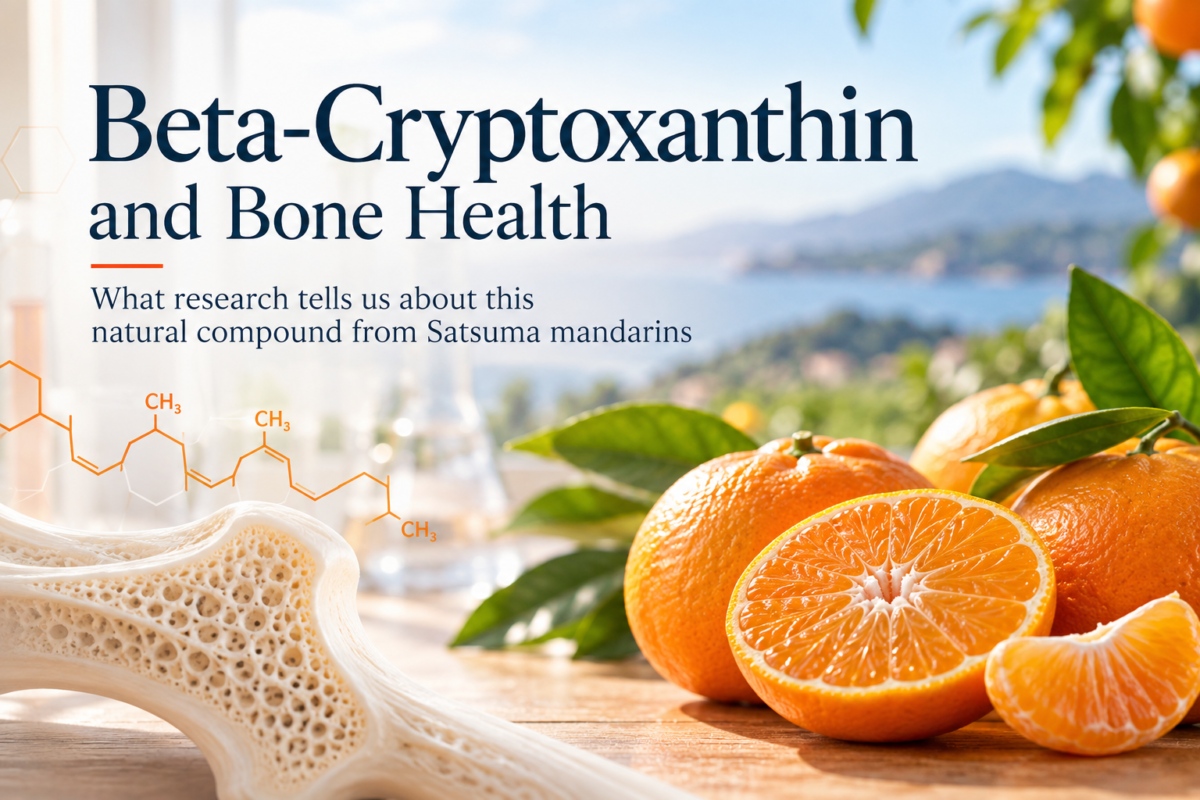
Beta-cryptoxanthin is a naturally occurring carotenoid found in a variety of fruits and vegetables—and it is particularly abundant in Satsuma mandarins, known as mikan in Japan.
Most people associate bone health with familiar nutrients such as calcium and vitamin D. But researchers have also investigated whether other dietary compounds may play a role in the complex process of bone remodeling.
Beta-cryptoxanthin is one of them.
Over the past several decades, research has examined beta-cryptoxanthin from several different perspectives. Laboratory studies have explored its effects on cells involved in bone formation and bone resorption. Small human intervention studies have measured changes in markers of bone metabolism after consuming beta-cryptoxanthin-rich beverages. And observational studies in Japan have investigated associations between blood levels of beta-cryptoxanthin and measures of bone health.
These findings are intriguing, but they need to be interpreted carefully. Laboratory findings do not automatically translate into clinical benefits, and observational associations do not prove that beta-cryptoxanthin prevents or treats osteoporosis.
So what does the research actually show?
This article takes a closer look at the evidence behind beta-cryptoxanthin and bone health—and, just as importantly, what that evidence does not yet prove.
What Is Beta-Cryptoxanthin, and How Is It Related to Bone Health?
Beta-cryptoxanthin is a carotenoid—a family of natural pigments responsible for many of the yellow, orange, and red colors found in fruits and vegetables.
It is found in foods including papaya, persimmons, red peppers, and citrus fruits. One particularly rich dietary source is the Satsuma mandarin (Citrus unshiu), a small, easy-to-peel citrus fruit widely eaten in Japan and commonly known there as mikan.

Beta-cryptoxanthin also has provitamin A activity, meaning the body can convert it into vitamin A when needed. But researchers have become interested in beta-cryptoxanthin for reasons beyond its role as a vitamin A precursor.
One area of research is bone metabolism.
Bone is living tissue that is continually renewed through a process known as bone remodeling. Cells called osteoblasts are involved in forming new bone, while osteoclasts break down older bone tissue. Maintaining bone health depends in part on the balance between these processes.
Laboratory studies have investigated how beta-cryptoxanthin may interact with these cellular processes. Human studies have approached the question differently, examining bone-metabolism markers or associations between beta-cryptoxanthin status and bone health.
Understanding the difference between these types of evidence is important—and we’ll look at each of them separately below.
Laboratory Research: What Happens in Bone Cells?
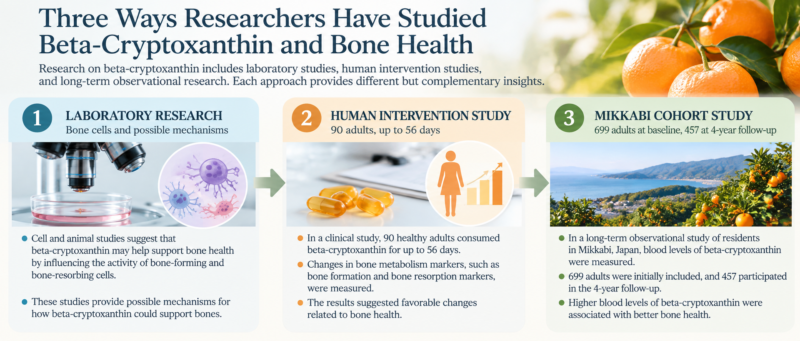
Much of the early research on beta-cryptoxanthin and bone metabolism was conducted in laboratory models using bone tissue and cultured cells.
These studies examined two important types of bone cells: osteoblasts, which are involved in forming new bone, and osteoclasts, which break down older bone tissue as part of the normal remodeling process.
In laboratory experiments, beta-cryptoxanthin has been associated with increased activity related to osteoblast function and bone mineralization. Other experiments found effects on the formation and activity of osteoclasts, including pathways involved in bone resorption.
These findings helped researchers develop a possible biological explanation for why beta-cryptoxanthin might be relevant to bone metabolism.
However, this distinction is important: these were primarily cell-culture and animal studies. They help us understand possible mechanisms, but they do not by themselves demonstrate that consuming beta-cryptoxanthin will increase bone density or prevent osteoporosis in humans.
That question requires human research.
Research: PMC — Role of carotenoid β-cryptoxanthin in bone homeostasis
Human Intervention Study: Changes in Bone Metabolism Markers
Researchers have also investigated beta-cryptoxanthin in humans.
In one intervention study, 90 adults between the ages of 27 and 65—including 36 postmenopausal women—were assigned to groups consuming a daily juice containing different amounts of beta-cryptoxanthin or a placebo juice.
The beta-cryptoxanthin groups received 1.5, 3.0, or 6.0 mg per day for up to 56 days.
Researchers measured several blood markers associated with bone formation and bone resorption. In participants consuming 3.0 or 6.0 mg of beta-cryptoxanthin per day, changes were observed in multiple markers of bone metabolism. Similar changes were also reported in the subgroup of postmenopausal women.
This study is interesting because it moves beyond laboratory models and examines biological responses in people.
But it is also important to understand what was measured.
The study evaluated circulating markers of bone metabolism—not changes in bone mineral density or fracture rates. A change in a biomarker is not the same as demonstrating that a nutrient prevents osteoporosis or fractures.
For questions about long-term bone health, we therefore need to look at a different kind of human evidence: observational studies that follow people over time.
Research paper: Human intervention study of beta-cryptoxanthin and bone metabolism (Journal of Health Science, 2006).
The Mikkabi Cohort Study: Beta-Cryptoxanthin and Bone Health Over Time
Some of the most interesting human evidence comes from Mikkabi, a mandarin-growing region in Shizuoka Prefecture, Japan.
The Mikkabi Study began by examining 699 adults—222 men and 477 women—and measuring factors including serum carotenoid levels and bone mineral density.
In the initial cross-sectional analysis, higher serum beta-cryptoxanthin levels were associated with higher radial bone mineral density in postmenopausal women, although the association became weaker after additional adjustment for dietary mineral and vitamin intake.
Researchers then continued to follow participants over time.
Four years later, 457 participants—146 men and 311 women—took part in a follow-up examination. Among the 212 postmenopausal women in this follow-up analysis, 15 developed new-onset osteoporosis during the four-year period.
After adjusting for multiple potential confounding factors, women with the highest baseline serum beta-cryptoxanthin concentrations had lower odds of developing osteoporosis than women in the lowest group. Higher beta-cryptoxanthin levels were also associated with a lower risk of developing osteopenia or osteoporosis.
These findings are noteworthy because they come from people observed over several years rather than from cells or short-term changes in blood markers.
However, the Mikkabi Study was observational. It can identify associations, but it cannot establish that beta-cryptoxanthin itself caused the lower risk. People with higher beta-cryptoxanthin levels may also differ in diet, lifestyle, or other factors that influence bone health.
Research papers: Mikkabi Study — cross-sectional analysis (2007) | four-year follow-up study (2012)
What the Research Shows—and What It Doesn’t Yet Prove
Taken together, the research on beta-cryptoxanthin and bone health is promising—but it is important to distinguish between what the evidence suggests and what it has actually demonstrated.
Laboratory studies provide a possible biological explanation for how beta-cryptoxanthin may influence processes involved in bone formation and bone resorption. Human intervention studies have also reported changes in blood markers associated with bone metabolism after beta-cryptoxanthin intake.
Longer-term observational research from Japan adds another piece to the picture. In the Mikkabi Study, higher blood levels of beta-cryptoxanthin were associated with more favorable measures of bone health in some analyses, including a lower incidence of osteoporosis among postmenopausal women during follow-up.
These different types of evidence point in an interesting direction, but they are not equivalent to proof that beta-cryptoxanthin prevents or treats osteoporosis.
Laboratory findings do not always translate into meaningful clinical effects in humans. Changes in bone-turnover markers do not necessarily mean that bone mineral density will increase or fractures will be prevented. And observational studies can identify associations, but they cannot fully separate the effects of beta-cryptoxanthin from other differences in diet, lifestyle, and overall health.
Most importantly, large, long-term randomized clinical trials examining outcomes such as bone mineral density and fracture risk are still limited.
For these reasons, beta-cryptoxanthin is best viewed as an interesting dietary compound being studied for its potential role in bone health—not as a treatment for osteoporosis or a replacement for established approaches to maintaining healthy bones.
Research Results Are Not Always Consistent
Not all studies of beta-cryptoxanthin and bone health have produced the same results.
While studies from Japan—particularly the Mikkabi Study—have reported associations between higher beta-cryptoxanthin levels and more favorable measures of bone health, research in other populations has been less consistent.
For example, the Framingham Osteoporosis Study followed older adults in the United States and examined dietary intake of several carotenoids in relation to bone mineral density and fracture risk. In these analyses, beta-cryptoxanthin intake was not significantly associated with bone mineral density or a lower risk of hip fracture.
Why might the results differ?
The studies involved different populations, diets, levels of beta-cryptoxanthin intake, methods of measuring exposure, and bone-health outcomes. Beta-cryptoxanthin intake is also generally higher in Japan than in the United States, particularly in regions where Satsuma mandarins are commonly consumed.
A 2016 review of beta-cryptoxanthin research noted these differences and concluded that variations in study design, population, and diet may help explain the inconsistent findings.
More recently, a systematic review and meta-analysis published in 2021 found that higher beta-cryptoxanthin intake was associated with a lower risk of osteoporosis and hip fracture across the observational studies analyzed. However, the authors also emphasized important limitations in the available evidence and called for further longitudinal studies and randomized controlled trials.
Taken together, the evidence remains encouraging, but not definitive. The differences between studies are another reason to view beta-cryptoxanthin as a promising area of nutritional research rather than as a proven treatment for osteoporosis.
Research reviews: 2016 review of β-cryptoxanthin research | 2021 systematic review and meta-analysis

How Beta-Cryptoxanthin Fits Into the Bigger Picture of Bone Health
Beta-cryptoxanthin is only one piece of a much larger bone-health picture.
Strong bones depend on many factors working together. Adequate calcium and vitamin D remain important, while protein and other nutrients contribute to maintaining the tissues that support movement and strength. Regular weight-bearing and resistance exercise also helps support bones and muscles, balance, and mobility.
For women during and after menopause, this broader perspective becomes especially important. Declining estrogen can affect the balance of bone remodeling, while changes in muscle mass and strength can influence mobility and the risk of falls.
Beta-cryptoxanthin adds an interesting nutritional dimension to this picture. Its presence in foods such as Satsuma mandarins, together with the laboratory, human intervention, and observational research discussed above, makes it a worthwhile subject for continued study.
But it should not be viewed in isolation—or as a substitute for established approaches to bone health.
Instead, the research on beta-cryptoxanthin offers another example of how foods and dietary patterns may contain compounds that contribute to the complex process of healthy aging.
For women interested in the broader picture, our guide to natural ways to support bone health during menopause explores how hormonal changes, nutrition, exercise, muscle strength, and Japanese dietary habits fit together.
Why Juveriente Became Interested in Beta-Cryptoxanthin
At Juveriente, our interest in beta-cryptoxanthin began with a simple question: could traditional Japanese foods offer useful clues for supporting healthy aging?
Satsuma mandarins have long been a familiar part of everyday life in Japan. Research from mandarin-growing regions such as Mikkabi drew our attention to beta-cryptoxanthin, one of the naturally occurring carotenoids found in particularly high concentrations in this fruit.
As we looked more closely at the research, what interested us was not a single dramatic finding, but the different layers of evidence—from laboratory studies of bone metabolism to human intervention studies and long-term observational research.
At the same time, the limitations of that evidence are important. Beta-cryptoxanthin should not be viewed as a treatment for osteoporosis, and bone health cannot be reduced to any single nutrient or dietary compound.
Instead, we see beta-cryptoxanthin as one interesting part of a broader approach to nutrition and healthy aging—an approach inspired in part by foods and dietary habits that have long been familiar in Japan.
From Research to Bone Strength Complex
This interest in beta-cryptoxanthin eventually became part of the thinking behind Juveriente® Bone Strength Complex.
The formula includes beta-cryptoxanthin from Satsuma mandarin extract together with nutrients commonly associated with maintaining healthy bones, including calcium, vitamin D, magnesium, and vitamin K.
The idea is not that beta-cryptoxanthin—or any supplement—can replace a balanced diet, regular physical activity, or appropriate medical care. Rather, Bone Strength Complex was developed as a nutritional option for people who want to support bone health as part of a broader healthy-aging lifestyle.
The research discussed on this page helps explain why beta-cryptoxanthin became an ingredient of particular interest to us. It should not, however, be interpreted as evidence that Bone Strength Complex prevents or treats osteoporosis.

The Bottom Line
Beta-cryptoxanthin is a fascinating example of how a naturally occurring compound in an everyday food can become the subject of scientific research.
Laboratory studies have suggested possible effects on processes involved in bone remodeling. Human intervention studies have reported changes in markers of bone metabolism, while observational studies—particularly those conducted in Japan—have found associations between higher beta-cryptoxanthin levels and certain measures of bone health.
At the same time, the evidence has important limitations. Results have not been completely consistent across populations, and the research available today does not establish beta-cryptoxanthin as a treatment for osteoporosis or as a substitute for established approaches to maintaining bone health.
Healthy bones are supported by the bigger picture: good nutrition, adequate calcium and vitamin D, regular physical activity, strong muscles, and appropriate medical care when needed.
Beta-cryptoxanthin may be one interesting part of that picture—and one that deserves continued research.