
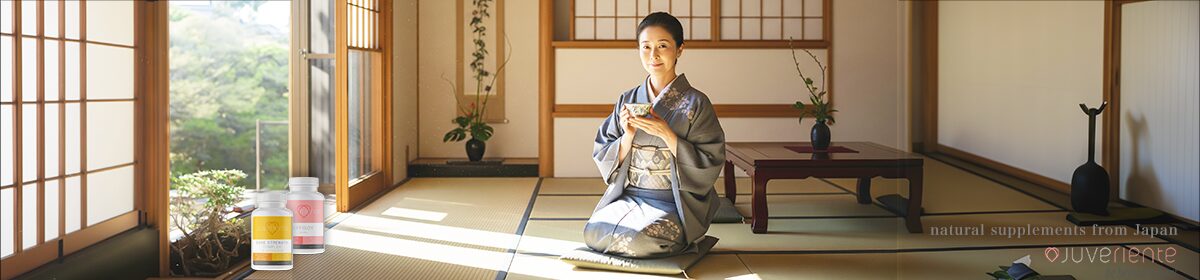

In Japan, Satsuma mandarins—known locally as Mikan—are one of the country’s most familiar fruits. Sweet, easy to peel, and especially popular during winter, they have been enjoyed by Japanese families for generations.
But few people, even in Japan, associate these everyday fruits with bone health.
Japanese researchers discovered something intriguing. Studies conducted in Mikkabi, a region famous for its mandarin oranges, found an association between higher blood levels of beta-cryptoxanthin—a natural carotenoid abundant in Satsuma mandarins—and favorable indicators of bone health.
This unexpected connection inspired Juveriente® Bone Strength Complex.
By combining a specialized Japanese Satsuma mandarin extract with essential bone-supporting nutrients, Juveriente brings a lesser-known area of Japanese nutritional research to women seeking to maintain healthy bones as they age.
A familiar fruit in Japan. An unexpected scientific discovery. A new approach to bone health support.
Mikan: Japan’s Everyday Mandarin Orange with an Unexpected Connection to Bone Health
Satsuma mandarins, commonly called Mikan in Japan, have been part of everyday Japanese life for generations. They are especially popular during winter, when families enjoy them at home as a simple, familiar snack.
These small, easy-to-peel citrus fruits are particularly rich in beta-cryptoxanthin, a naturally occurring carotenoid that has attracted scientific interest for its potential relationship with bone health.
One important center of this research is Mikkabi, a mandarin-growing region in Shizuoka Prefecture, Japan.
Because Mikan consumption varies among residents, researchers have been able to investigate the relationship between blood beta-cryptoxanthin levels and indicators of bone health.
What makes this story particularly interesting is that Mikan was never traditionally regarded as a special food for bones. Its potential significance emerged through scientific research rather than conventional wisdom.

What Japanese Researchers Discovered About Mikan and Bone Health
In Mikkabi, a mandarin-growing region of Japan, researchers from the National Agriculture and Food Research Organization (NARO) investigated a fascinating question: Could the beta-cryptoxanthin found in Satsuma mandarins be associated with healthier bones?
The Mikkabi Study examined the relationship between blood levels of beta-cryptoxanthin and bone health in local residents.
An initial study involving 699 adults found that higher blood levels of beta-cryptoxanthin were associated with higher bone mineral density in postmenopausal women, although the strength of the association varied with statistical adjustments.
Researchers also conducted a four-year follow-up study. Among the postmenopausal women studied, those with the highest initial blood levels of beta-cryptoxanthin had lower odds of developing osteoporosis than those with the lowest levels, after adjustment for several potential influencing factors.
These findings suggested an intriguing connection between a familiar Japanese fruit and bone health, particularly for women after menopause.
Importantly, these were observational findings. They do not prove that eating Mikan or taking beta-cryptoxanthin supplements prevents osteoporosis. However, they helped establish beta-cryptoxanthin as an interesting subject for further bone-health research.

For a closer look at the original studies, their findings, and their limitations, read our detailed research review: Beta-Cryptoxanthin and Bone Health: What Does the Research Show?
How Bone Remodeling Works—and Why It Matters After Menopause
Our bones may seem solid and unchanging, but they are living tissues that continuously renew themselves throughout life. This natural process is called bone remodeling.
Two types of cells play essential roles in this process:
- Osteoclasts break down and remove old or damaged bone tissue. This process is called bone resorption.
- Osteoblasts build new bone tissue to replace what has been removed. This process is called bone formation.
When these activities are properly balanced, the body can maintain healthy bone structure.

For illustrative purposes only.
However, during and after menopause, declining estrogen levels can disrupt this balance. Estrogen normally helps regulate bone resorption. As estrogen levels fall, osteoclast activity may increase, causing bone to be broken down faster than it can be replaced.
Over time, this imbalance can contribute to bone loss and increase the risk of osteoporosis.
This is why supporting healthy bone remodeling becomes particularly important for women during and after menopause.
Understanding this process also helps explain why Japanese researchers became interested in beta-cryptoxanthin and its potential relationship with bone metabolism.
What Helps Support Bone Health After Menopause?
Maintaining healthy bones after menopause requires more than any single nutrient or supplement. Bone health depends on a combination of nutrition, physical activity, hormonal changes, and other individual factors.
Calcium and vitamin D are essential for maintaining normal bone structure and supporting calcium absorption. A balanced diet that provides adequate protein and other nutrients also contributes to overall musculoskeletal health.
Weight-bearing exercise and resistance training help maintain bone strength, muscle function, and balance. These activities become especially important with age, when both bone and muscle health can affect mobility and independence.
For women at increased risk of osteoporosis, bone density screening and appropriate medical care are also important. Prescription treatments can reduce fracture risk in people who need them, and decisions about treatment should be made with a qualified healthcare professional.
Beyond these established approaches, researchers have also investigated additional dietary compounds that may be associated with bone health.
One of these compounds is beta-cryptoxanthin, a naturally occurring carotenoid found in Satsuma mandarins. Japanese research has explored its relationship with bone metabolism, opening an interesting area of nutritional science.
Beta-cryptoxanthin should not be viewed as a replacement for calcium, vitamin D, exercise, or prescribed osteoporosis treatment. Rather, it represents an additional subject of research into the relationship between nutrition and healthy aging.
For a broader guide to nutrition, exercise, and everyday habits, explore our article: Natural Ways to Support Bone Health in Menopause.
From Japanese Mikan Research to a Specialized Beta-Cryptoxanthin Extract
While Japanese researchers were investigating the relationship between Mikan consumption, beta-cryptoxanthin levels, and bone health, Japanese ingredient manufacturers were also exploring ways to make use of the fruit’s naturally occurring compounds.
Unitika Ltd., a Japanese company, developed a Satsuma mandarin extract ingredient using specialized processing techniques. This development helped make Mikan-derived compounds available in a concentrated ingredient form, rather than relying solely on eating the fruit.
Beyond the observational findings from the Mikkabi Study, experimental research has also investigated how beta-cryptoxanthin may interact with the cells involved in bone remodeling.
Laboratory and animal studies have explored two potential mechanisms:
- Bone resorption: Beta-cryptoxanthin has been studied for its potential effects on osteoclasts, the cells responsible for breaking down bone tissue.
- Bone formation: Researchers have also investigated its potential influence on osteoblasts, the cells involved in building new bone.
These experimental findings provide possible biological explanations for researchers’ interest in beta-cryptoxanthin. However, they do not establish that taking a beta-cryptoxanthin supplement prevents or treats osteoporosis in humans.
From Traditional Japanese Food to Everyday Nutritional Support
In Japan, Mikan has been enjoyed as an everyday fruit for generations. The research into beta-cryptoxanthin has added a new scientific perspective to this familiar part of Japanese food culture.
However, regularly consuming substantial amounts of Satsuma mandarins may not be practical for everyone, especially outside Japan, where fresh Mikan can be difficult to find.
This creates an interesting opportunity: using carefully processed Mikan-derived ingredients to make naturally occurring compounds such as beta-cryptoxanthin available in a convenient supplement format.
A supplement is not equivalent to eating whole fruit, and the research on beta-cryptoxanthin should not be interpreted as proof that supplementation prevents osteoporosis. Nevertheless, the development of specialized Mikan extracts has made this Japanese nutritional ingredient more accessible to consumers beyond Japan.
Introducing Juveriente® Bone Strength Complex: Japanese Mikan Extract and Essential Bone Nutrients
When Juveriente® was established in 2016, our goal was to introduce distinctive Japanese health ingredients to women in the United States.
One ingredient that caught our attention was an enzyme-treated Satsuma mandarin extract developed by Unitika Ltd. in Japan. Inspired by Japanese research into beta-cryptoxanthin and bone health, we wanted to make this specialized ingredient more accessible to American consumers.
This led to the development of Juveriente® Bone Strength Complex, combining Japanese Mikan-derived ingredients with selected nutrients traditionally associated with bone health, including calcium and vitamins.
Rather than relying on a single nutrient, our formulation reflects the idea that maintaining healthy bones involves multiple nutritional factors.
Since its launch, Bone Strength Complex has represented our commitment to bringing carefully selected Japanese ingredients and nutritional knowledge to women seeking to support their bone health as they age.
Interested in the Japanese Mikan extract featured in Bone Strength Complex? Explore the product on Amazon.com.
Learn More About Bone Strength Complex
Interested in exploring the formulation in more detail? You can review the ingredients, serving information, and product details below before deciding whether Bone Strength Complex fits your nutritional needs.
Ready to explore Bone Strength Complex? View the product details and purchasing options at the Juveriente Online Shop or Amazon.com.

Important Information
Juveriente® Bone Strength Complex is a dietary supplement formulated with Satsuma mandarin extract and selected nutrients that support normal bone health.
For ingredient amounts and serving instructions, please refer to the Supplement Facts and product label shown above.
Bone health is influenced by many factors, including nutrition, physical activity, age, and hormonal changes. Dietary supplements are intended to complement a balanced lifestyle, not replace appropriate medical care.
If you have osteoporosis, are taking medications, or have questions about your bone health, consult a qualified healthcare professional before using this supplement.