
Menopause is a natural stage of life, but every woman experiences it differently.
Some women go through menopause with relatively few symptoms. Others struggle with hot flashes, night sweats, sleep problems, mood changes, fatigue, and other symptoms that can interfere with everyday life.
Hormone replacement therapy (HRT) can be a highly effective treatment for menopausal symptoms. However, some women cannot use HRT for medical reasons, while others simply prefer to explore nonhormonal approaches first.
So, can you manage menopause without HRT?
For many women, the answer is yes.
But choosing not to use HRT does not mean doing nothing. Nor does it mean relying only on “natural remedies.”
Today, women have a range of options, from nonhormonal medical treatments to exercise, diet, sleep, and stress management.
At Juveriente®, we have also spent years looking at another fascinating area: the traditional Japanese diet, soy isoflavones, and fermented soy.
In This Article, You’ll Learn
If you’re looking for ways to manage menopause without hormone replacement therapy (HRT), there are more options than you might think.
In this article, we’ll explore:
- Nonhormonal options that may help manage common menopause symptoms such as hot flashes and sleep problems
- Lifestyle and dietary approaches that can support your health and well-being during menopause
- What research says about soy isoflavones, including fermented soy and isoflavone aglycones
There is no single approach that works for every woman. The goal is to understand your options and find the combination that works best for your body, lifestyle, and health needs.
Can You Manage Menopause Without HRT?
Many women go through menopause without using hormone replacement therapy.
That does not mean that natural approaches are necessarily better than HRT.
HRT can be particularly effective for symptoms such as hot flashes and night sweats. Whether it is appropriate for an individual woman depends on factors including her health history, age, symptoms, and personal preferences.
The important point is not to think of menopause management as a simple choice between:
HRT or natural remedies.
There are many options in between.
If menopausal symptoms are significantly affecting your sleep, work, or quality of life, it is worth discussing the available options—including HRT—with a qualified healthcare professional.
Nonhormonal Treatments for Menopause Symptoms
When people hear “menopause without HRT,” they may immediately think about herbs or supplements.
But nonhormonal medical treatments are also available.
Certain SSRIs and SNRIs, gabapentin, and other medications may be used to help manage vasomotor symptoms such as hot flashes and night sweats.
More recently, nonhormonal medications that target neural pathways involved in the body’s temperature regulation have also become available.
In other words:
Without HRT does not mean without medical treatment.
If your symptoms are severe or are interfering with everyday life, talking with a healthcare professional should be part of the conversation.
Common Menopause Symptoms and Non-HRT Options
| Symptom | Options to consider |
|---|---|
| Hot flashes | Nonhormonal medication, cooling strategies, lifestyle changes |
| Night sweats | Temperature management, sleep environment, medical options |
| Sleep problems | Sleep habits, exercise, addressing night sweats |
| Mood changes | Exercise, stress management, professional support |
These options serve different purposes. Some nonhormonal medications have demonstrated effectiveness for hot flashes, while lifestyle strategies may improve comfort, sleep, and overall well-being without necessarily reducing hot flash frequency.
Lifestyle Still Matters
Whether or not you use medication, everyday lifestyle habits matter during and after menopause.
Lifestyle changes may not eliminate every menopausal symptom, but movement, sleep, nutrition, and stress management can support your health well beyond the menopausal transition.
Keep Moving
Walking, strength training, and other forms of regular physical activity can help support your muscles, bones, cardiovascular health, mood, and overall well-being.
This becomes particularly important after menopause, when both bone and muscle loss can accelerate.
You do not necessarily need an intense exercise program.
Walking, taking the stairs, shopping, gardening, and simply continuing to move throughout the day all count.
Staying active is not just about managing your weight. It is also about protecting your ability to stay active and independent as you grow older.
Protect Your Sleep
Hot flashes and night sweats can make good sleep difficult.
Keeping your bedroom cool, reconsidering the timing of caffeine and alcohol, and maintaining a regular sleep schedule may help create a better environment for sleep.
If sleep problems persist for a long time, however, it may be worth discussing them with a healthcare professional, since menopause is not the only possible cause of poor sleep.
Find Your Way to Relax
Stress cannot always be avoided, especially during midlife.
For many women, menopause arrives at the same time as career pressures, caring for aging parents, family responsibilities, and other major life changes.
Walking, reading, spending time with friends, or simply setting aside quiet time can all help.
In Japan, soaking in a warm bath has long been part of everyday life.
A bath should not be thought of as a “menopause treatment.” But the Japanese habit of creating a little time at the end of the day to relax both body and mind may still be worth borrowing.
What You Eat During Menopause Matters
Menopause is not only about dealing with the symptoms you are experiencing today.
It is also a good time to think about your health 10 or 20 years from now.
A balanced diet built around vegetables, fruits, fish, whole grains, legumes, and good sources of protein provides a strong foundation for healthy aging.
Bone health deserves particular attention after menopause.
Estrogen decline can accelerate bone loss, so it is important to think beyond calcium alone. Vitamin D, protein, magnesium, physical activity, and other factors also play important roles in maintaining strong bones.

There is no single miracle food that can “solve” menopause.
What matters much more is the pattern of small choices you make every day.
What Can We Learn From Japanese Women?
This brings us to a subject that Juveriente has been interested in for many years.
Historically, researchers have reported differences in how Japanese and Western women experience and report menopausal symptoms.
That does not mean we can simply say:
“Japanese women have fewer menopausal symptoms because they eat soy.”
The reality is much more complicated.
Diet, body composition, lifestyle, genetics, cultural differences in how symptoms are perceived and reported, and many other factors may all play a role.
For a broader look at the dietary traditions behind healthy aging in Japan, explore why Japanese food is considered healthy and its connection to longevity.
Nevertheless, one part of the traditional Japanese diet has attracted considerable scientific interest:
Why Juveriente Is Interested in Fermented Soy
Traditional Japanese diets include many soy foods, including fermented soy. Juveriente has focused particularly on aglycone isoflavones—the form produced when fermentation removes the sugar portion from isoflavone glycosides.
Learn more about aglycone isoflavones and the research behind them ↓
Why Are Soy Isoflavones Called Phytoestrogens?
Soybeans naturally contain compounds called isoflavones.
Because their molecular structures have some similarities to estradiol and they can interact with estrogen receptors, isoflavones are often described as phytoestrogens, or plant estrogens.
But this term can easily cause misunderstanding.
Soy isoflavones are not estrogen.
Their estrogen-like activity is far gentler than that of the body’s own estrogen.
So eating soy is not the same thing as taking estrogen.
During menopause, the body’s estrogen levels decline substantially. Isoflavones can interact weakly and selectively with estrogen receptors, which is one reason researchers have been interested in their potential role during menopause.
The key idea is not that soy “replaces estrogen,” but that isoflavones have a much gentler estrogen-like interaction with the body.
Glycoside vs. Aglycone: Not All Isoflavones Are the Same
At Juveriente, we have been particularly interested not only in how much isoflavone you consume, but also in what formit takes.
Many isoflavones found naturally in soy foods are present as glycosides.
A glycoside has a sugar molecule attached to it. Before it can be absorbed in aglycone form, that sugar portion must first be removed in the digestive tract.
In simple terms:
Glycoside → removal of the sugar portion → Aglycone
Aglycone isoflavones have already had this sugar portion removed.
And this is where something familiar from traditional Japanese food culture becomes especially interesting:
fermentation.
Fermentation Does Part of the Work Before We Eat
Japan has a long tradition of eating fermented soy foods.
One of the most familiar examples is miso.
Miso, natto, and soy sauce are all traditional Japanese fermented soybean foods, but their fermentation processes differ considerably. These differences can also influence the composition of soy isoflavones.
To explore how these foods are made and how fermentation affects their nutritional properties, read our guide to fermented soybeans, their health benefits, and isoflavones.
During fermentation, microorganisms and their enzymes transform compounds in soy. One of these changes is the conversion of some isoflavone glycosides into their aglycone forms.
In a sense, fermentation performs part of the transformation before we eat the food.
As a result, aglycone isoflavones can differ from glycosides in how quickly they become available for absorption.
This is why we believe it is worth looking beyond simply asking:
“How many milligrams of soy isoflavones does this contain?”
Another useful question is:
“What form are those isoflavones in?”
So, Should We Just Eat More Miso?
At this point, there is an obvious question.
If fermented soy contains aglycone isoflavones, why not simply drink more miso soup?
Miso is a wonderful traditional Japanese food, and it can certainly be part of a healthy diet.
But simply increasing miso consumption is not necessarily the answer.
Miso also contains salt. Drinking more and more miso soup simply to increase your intake of fermented soy isoflavones would therefore not be a sensible strategy.
There is also a practical cultural issue.
For someone who grew up in Japan, a bowl of miso soup may feel like an ordinary part of daily life. For a woman who grew up with a completely different food culture, drinking miso soup every day may not be realistic or appealing.
The goal is not to copy the Japanese diet literally.
A better approach is to ask what we can learn from traditional Japanese food culture—and how some of those ideas might fit into modern life.
What Does the Research Say About Aglycone Isoflavones?
This is where we need to separate an interesting idea from scientific evidence.
What One Clinical Study Found
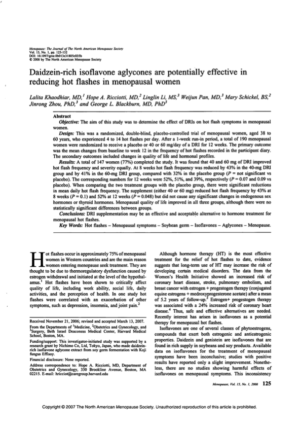
In a randomized, double-blind, placebo-controlled study, postmenopausal women with hot flashes received 40 mg or 60 mg per day of daidzein-rich isoflavone aglycones.
Hot flash frequency decreased by approximately 43%–52%
after 8 to 12 weeks in the supplementation groups.
That does not mean that aglycone isoflavones have been proven to eliminate hot flashes or that they work for every woman.
Research on soy isoflavones and menopausal symptoms as a whole has produced mixed results.
But studies such as this raise an interesting question: rather than treating all “soy isoflavones” as identical, should we also be paying attention to their form and composition?
We think that question is worth exploring.
Another Interesting Finding: AglyMax® and DHEA-S
There is another area of research that has attracted our attention.
AglyMax® is a daidzein-rich isoflavone aglycone ingredient produced from fermented soy germ.
In an eight-week open-label feasibility study, 40 Japanese menopausal women consumed 20–40 mg per day of AglyMax®, a fermented soybean germ extract rich in isoflavone aglycones.
Their average blood DHEA-S level increased from 890 ± 112 ng/ml at baseline to 2,430 ± 210 ng/ml after eight weeks.
Because this was a small, open-label study without a placebo control group, the observed increase in DHEA-S cannot be attributed conclusively to AglyMax®. Larger, well-controlled clinical studies are needed to determine whether this finding is reproducible and clinically meaningful.
Reference 2 (Symposium Presentation) 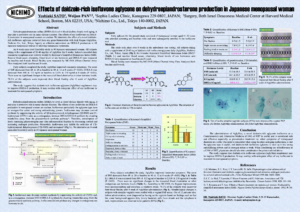
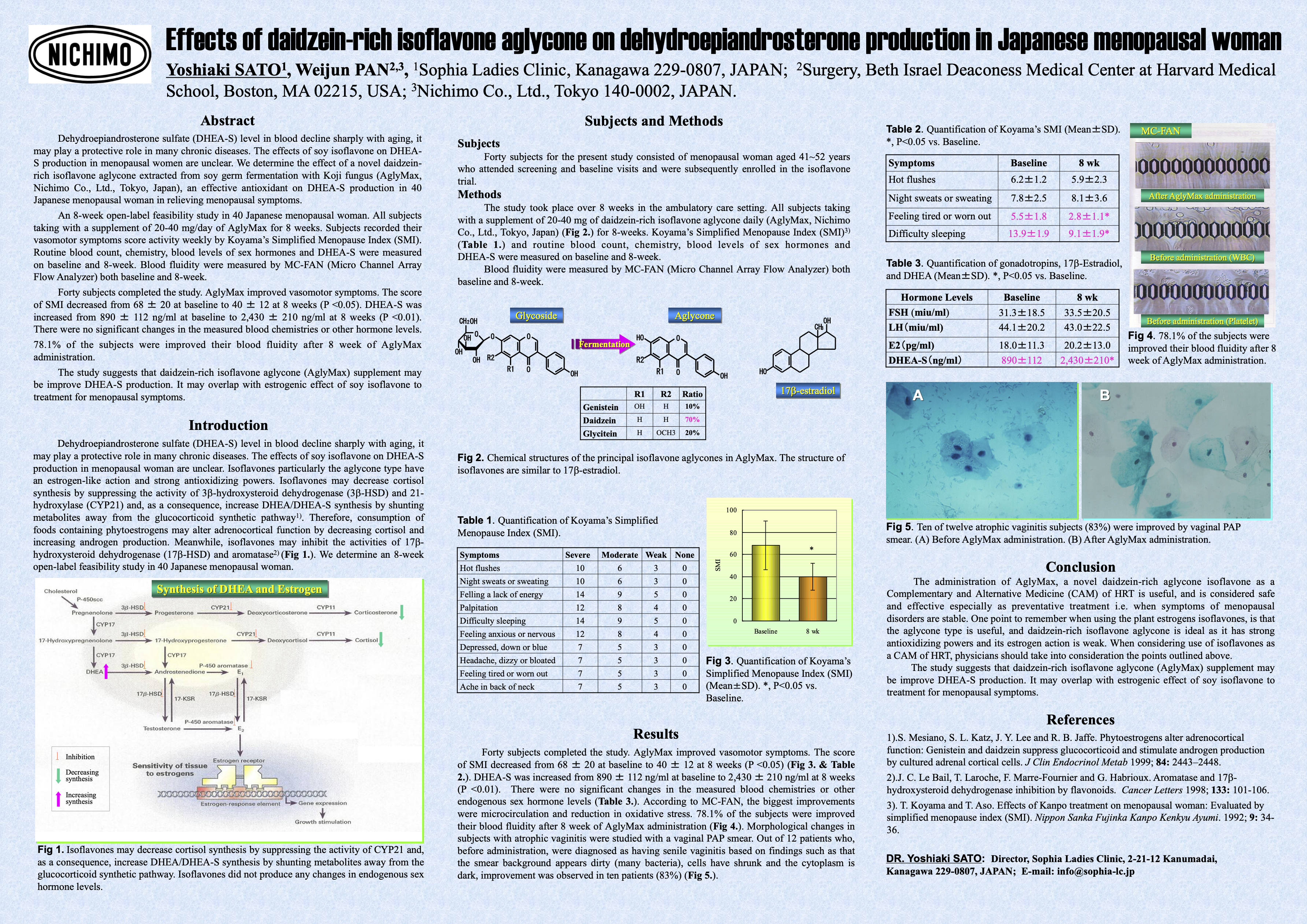
Importantly, the researchers reported no significant changes in the other measured endogenous sex hormone levels.
That last point is important.
This study does not show that AglyMax simply raises estrogen.
Instead, it points toward another potentially interesting relationship between soy isoflavones and the body’s steroid hormone pathways.
A Possible Mechanism Behind the DHEA Finding
Why might soy isoflavones influence DHEA-S?
Laboratory research using human adrenal cortical cells provides one possible clue.
Researchers found that the soy isoflavones genistein and daidzein decreased cortisol production under certain experimental conditions, while DHEA and DHEA-S production increased in some adrenal cell models.
One mechanism proposed by the researchers is that suppressing part of the cortisol synthesis pathway could leave more steroid precursors available for DHEA synthesis.
This is especially interesting because DHEA is a precursor in the body’s pathways for producing both androgenic and estrogenic sex steroids. The researchers therefore proposed that increased adrenal androgen production could potentially contribute indirectly to some of the biological effects associated with dietary phytoestrogens.
But we need to be careful here.
This does not prove that taking AglyMax causes the body to produce exactly the estrogen it needs.
That would go beyond what these studies demonstrate.
What the research does give us is an interesting scientific reason to continue investigating how soy isoflavones may interact with the body’s own hormone pathways.
Reference 3 (Laboratory Study)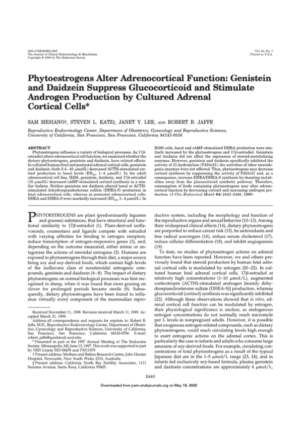
From Japanese Food Culture to Modern Menopause Support
Now we can bring the pieces together.
For generations, people in Japan have eaten soy not as a special “menopause food,” but simply as part of everyday life—in tofu, miso, natto, and many other foods.
Some of those foods are fermented.
Modern research has allowed us to look more closely at what happens during that fermentation and to distinguish between different forms of isoflavones.
The story becomes:
Soy → Isoflavones → Glycoside and Aglycone Forms → Fermentation → Absorption and Metabolism
This does not mean that copying the Japanese diet will automatically give someone the health outcomes of a Japanese woman.
Instead, our approach at Juveriente is to look at traditional Japanese food culture, identify ideas that are scientifically interesting, and then examine what modern research actually tells us about them.
Where AglyMax® and Juveriente® Effisoy® Fit In
Juveriente® Effisoy® AM/PM contains AglyMax®, a daidzein-rich aglycone isoflavone ingredient derived from fermented soy germ.
There is an important distinction we want to make clear.
The research discussed above was not conducted on the current Juveriente® Effisoy® finished product.
The studies investigated AglyMax® or daidzein-rich isoflavone aglycone preparations related to the ingredient approach used in our product.
Effisoy is not HRT, and it should not be considered a replacement for medical treatment.
Rather, it was created for women who are interested in soy isoflavones—and particularly in the fermented, aglycone form—as one part of their daily approach to healthy aging and menopause support.
Our Effisoy® menopause support guide explains the thinking behind our formula and why we chose fermented soy germ as its foundation.
Interested in why we chose AglyMax® for Effisoy®?
Learn more about Effisoy® and AglyMax® →
Prefer to hear from women who have actually used Effisoy®?
Read real Effisoy® customer stories →
Menopause Without HRT Is Not One-Size-Fits-All
There is no single correct way to manage menopause.
For some women, HRT may be the right choice.
Others may benefit from nonhormonal medications.
Some women may have relatively mild symptoms and focus primarily on nutrition, exercise, sleep, stress management, and other everyday habits.
Soy isoflavones are one more area that has been studied within this much larger picture.
Menopause is also about more than getting through hot flashes and night sweats.
It can be a time to think about the decades ahead: keeping your bones strong, maintaining your muscles, staying active, going where you want to go, and continuing to enjoy the things that matter to you.
For a broader look at protecting your long-term health, explore our guide to natural ways to support bone health during menopause.
There are things we can learn from traditional Japanese food culture. There are things we can learn from modern medicine. And there are things we are continuing to learn from nutrition science.
None of them needs to be treated as the one and only answer.
The goal is to understand your options, look at the evidence, and find an approach that fits your own body, health, and life.